
Every self-published author eventually reaches the same fork in the road. The manuscript is finished, the cover is ready, the upload screens are open, and one field keeps asking the same question: ISBN? The free option from the platform is sitting right there. A paid option costs real money. Most guides online were written when the publishing landscape looked different, and the decisions they recommend may no longer match the trade-offs that exist in 2026.
Caliana Press made its choice early. We bought a 100-block from Bowker, registered our first title across five formats, and have been watching how those identifiers move through the supply chain ever since. What follows is what we’ve learned, what we would tell a first-time publisher, and what we would do differently if we were starting over.
This guide is educational. Nothing here is legal or tax advice. ISBN rules are set by the International ISBN Agency and administered in each country by a designated registration authority. Verify the specifics for your jurisdiction before making a purchase decision.
What an ISBN Actually Is
The International Standard Book Number is a thirteen-digit identifier that distinguishes one book product from every other book product in the world. It lives on the back cover inside the EAN-13 barcode, on the copyright page inside the book, and in the metadata records that supply chain participants use to order, track, and sell titles. Libraries reference it to order, bookstores to track, distributors to ship, wholesalers to invoice, retailers to list.
Every thirteen-digit ISBN breaks into five parts, each separated by a hyphen when printed formally. The parts don’t change in function, but their lengths vary depending on the registration group and the size of the block the publisher purchased.
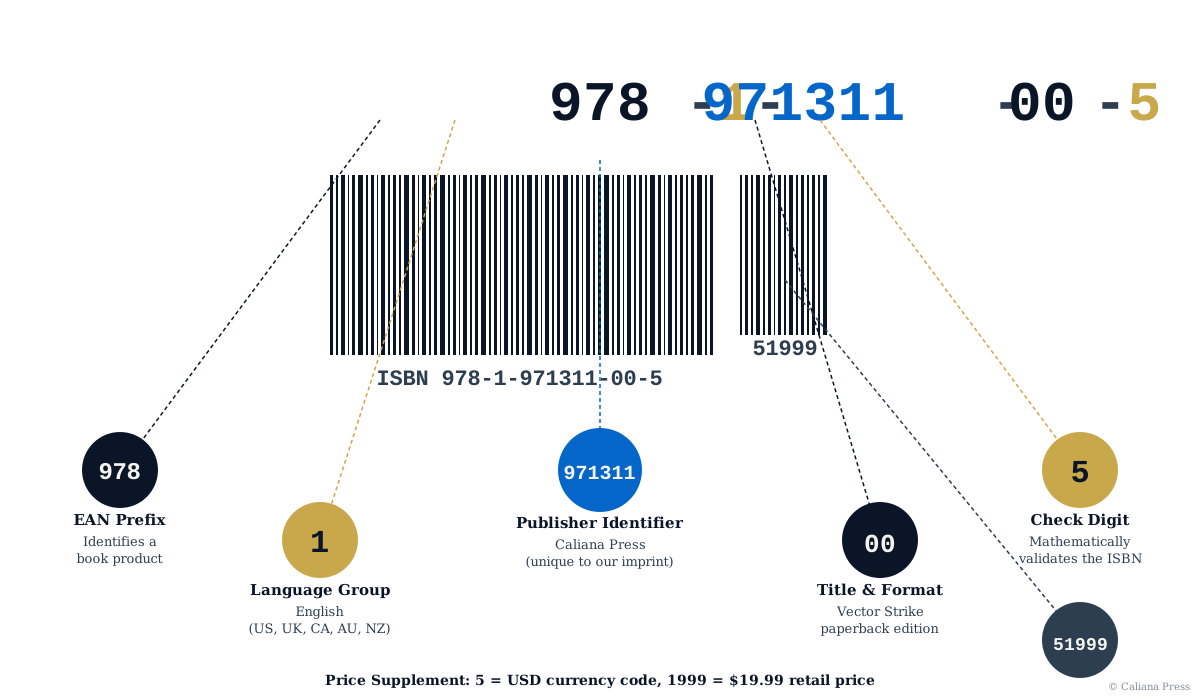
For Vector Strike’s paperback edition, our ISBN is 978-1-971311-00-5. The diagram below shows what each segment carries.
Reading the parts:
- 978 — the EAN prefix indicating a book product. Some newer ISBNs begin with 979 as the original 978 registry fills up.
- 1 — the registration group. For English-language countries (United States, United Kingdom, Canada, Australia, New Zealand), this digit is 0 or 1.
- 971311 — the publisher identifier. This sequence is unique to Caliana Press and appears on every ISBN in our block.
- 00 — the title and edition identifier. Our first assignment; every Caliana Press title and format gets its own.
- 5 — the check digit, mathematically derived to validate the other twelve numbers.
The EAN-13 barcode on the back cover also includes a supplementary five-digit code. For Vector Strike paperback, the supplement is 51999, where “5” indicates USD and “1999” indicates the retail price of $19.99. Books sold in multiple currencies or with variable pricing often use 90000 as a placeholder code instead.
One detail worth knowing. Anyone familiar with how ISBN blocks are structured can look at the publisher identifier and infer roughly how many ISBNs the publisher purchased. A six-digit publisher identifier suggests a block of 100. A seven-digit identifier suggests a block of 10. A five-digit identifier suggests a block of 1,000 or more. Professional buyers occasionally use this as a quick signal of scale when evaluating a new imprint.
When You Need an ISBN
The requirement depends on format and distribution channel.
Always required
Any print book — paperback, hardcover, mass-market — sold through retail or wholesale distribution. Audiobooks sold commercially. Any format intended for ingestion into Books in Print, library systems, or the wholesale supply chain.
Practically required
Ebooks sold through most retailers other than Amazon. Apple Books, Kobo, Barnes & Noble Press, and Google Play all accept an ISBN, and several request it as a condition of distribution or featured placement. OverDrive, which supplies most public and school library ebook lending, requires one.
Not strictly required
Ebooks sold exclusively through Amazon Kindle Direct Publishing, where the platform assigns its own ASIN (Amazon Standard Identification Number). Personal-use print runs, proofs, galleys, or promotional materials not intended for commercial sale.
Each format gets its own ISBN. A novel released in paperback, hardcover, ebook, and audiobook uses four distinct ISBNs. A large-print edition needs a fifth. A significantly revised second edition needs a sixth. Translations into different languages each need their own.
A few changes don’t require a new ISBN: a price update, a new cover design (as long as the content doesn’t meaningfully change), minor typographical corrections, or a change of printer or print-on-demand vendor while the product itself remains the same.
Where ISBNs Come From
Every country has an official ISBN registration authority designated by the International ISBN Agency. Pricing varies dramatically across borders, and that variation is worth understanding before you buy.
In the United States and its territories, Bowker is the sole official registration authority. ISBNs purchased through any other US-based channel are either resold from Bowker or assigned by the distributor (Amazon, Draft2Digital, Lulu, and similar platforms) under their own publisher-of-record status.
In the United Kingdom, Nielsen administers ISBNs.
In Canada, ISBNs are free to Canadian citizens and residents, administered through Library and Archives Canada.
In India, Brazil, and many other countries, ISBNs are issued free or at low cost by national library systems.
The global variation reflects different policy philosophies about whether ISBNs should be a public service or a commercial product. The practical consequence: your country of residence determines where you apply, what you pay, and whether free ISBNs are even available to you.
The 2026 Pricing Reality (United States, Bowker)
| Quantity | Price | Per-ISBN Cost |
|---|---|---|
| 1 | $125 | $125.00 |
| 10 | $295 | $29.50 |
| 100 | $575 | $5.75 |
| 1,000 | $1,500 | $1.50 |
A single ISBN is the least efficient per-unit purchase. Bowker’s block pricing rewards commitment. The more ISBNs a publisher buys at once, the less each one costs.
For a first-time author publishing a single novel in three formats (paperback, hardcover, ebook), the arithmetic is straightforward. Three ISBNs at $125 each equals $375. A block of 10 at $295 costs $80 less overall and leaves seven ISBNs available for future projects. The 10-block almost always makes more sense than buying singles, even for an author uncertain whether they’ll publish again.
The 100-block becomes attractive once a publisher is confident they’ll use more than 20 ISBNs over their catalog. At $5.75 each, it represents a 95% reduction from the single-ISBN price. The trade-off is a larger upfront commitment and, in practice, some identifiers that may sit unused if publishing plans shift.
The Free ISBN Options: What You Gain and Lose
Several platforms offer free ISBNs as part of their distribution services. Each comes with constraints worth understanding before you accept.
Amazon KDP free ISBN. Free to use, with the publisher-of-record field populated by Amazon-controlled imprint names such as “Independently published.” The ISBN is valid only for distribution through KDP’s channels (Amazon retail and KDP’s Expanded Distribution). It cannot be moved to other platforms.
Draft2Digital free ISBN. Assigned automatically to titles distributed through D2D’s network. Lists Draft2Digital as publisher of record. Usable only through D2D’s distribution channels.
Lulu free ISBN. Offered for books published through Lulu’s platform. Lists Lulu as publisher of record and binds the ISBN to Lulu distribution.
IngramSpark paid ISBN. Priced around $85 at publication, offered as a budget alternative to a single Bowker ISBN. Lists the author as publisher but restricts the ISBN to titles distributed through Ingram’s catalog.
The common thread across all platform-issued ISBNs: the identifier travels with the platform, not with the author. If an author later decides to move to a different distributor, expand to a new retailer, or restructure their distribution, the platform ISBN cannot come along. A new ISBN has to be issued for the new distribution relationship. That new identifier creates a fresh record in Books in Print, can fragment review histories tied to the original identifier in some retailer databases, and produces catalog cleanup work that takes months or years to fully resolve.
What the free options are good for: a writer publishing one book exclusively on one platform, never intending to move, never intending to expand. For that writer, free is a sensible choice.
What the free options trade away: flexibility, portability, and publisher-of-record status. For a writer building a catalog under their own imprint, those elements matter. For a writer who plans to stay on one platform indefinitely, they may not.
The decision is not about right or wrong. It’s about matching the identifier strategy to the publishing plan.
How Many ISBNs to Buy
The calculation depends on three variables: how many distinct titles you plan to publish, how many formats per title, and how confident you are in those projections.
A rough exercise: take your planned titles over the next three years, multiply by the number of formats each title will release in (typical indie: paperback + ebook = 2; full-service indie: paperback + hardcover + ebook + audiobook = 4), and add a 20% buffer for revisions, translations, and projects you haven’t yet imagined.
Three scenarios for reference:
An author planning three novels in paperback and ebook over three years needs six ISBNs minimum. The 10-block is the correct choice.
An author planning a catalog of twelve books in four formats each needs 48 ISBNs. The 100-block is the correct choice and leaves room for growth.
An author uncertain whether they’ll publish more than one title is generally better served by the 10-block than a single purchase, because the math favors the block even at low usage rates.
Unused ISBNs don’t expire. They remain in the publisher’s Bowker account indefinitely.
When You Need a New ISBN
New ISBN required:
- Any new format of the same title (paperback, hardcover, ebook, audiobook each needs its own)
- A significantly revised edition with new content
- A large-print or accessible-format edition
- A translation into a different language
- A bundled or omnibus edition containing multiple works
- A different trim size of the same book if sold as a distinct product
New ISBN not required:
- Price changes
- Minor typographical corrections
- A new cover design when the content is materially unchanged
- Switching printers or print-on-demand vendors
- Changing the list price in a specific market
ISBNs and Ebooks
The most common question first-time publishers ask: do ebooks really need an ISBN?
The honest answer depends on where you plan to sell.
For Amazon-exclusive ebooks, the answer is no. Amazon assigns an ASIN automatically and does not require an ISBN. Authors enrolled in Kindle Unlimited through KDP Select typically publish without an ebook ISBN and lose nothing by doing so.
For ebooks sold through Apple Books, Kobo, Barnes & Noble Press, Google Play, or distributed through an aggregator that feeds OverDrive and library systems, an ISBN is either required or strongly encouraged. Authors without one receive a platform-assigned identifier, which travels only within that platform.
For library distribution specifically, an ISBN is effectively mandatory. OverDrive, which supplies most US public and school library ebook collections, requires ISBNs for ingested titles. Libraries check for ISBNs when evaluating titles for acquisition.
The ebook ISBN question ultimately maps to distribution strategy. An author publishing wide (multiple retailers, library accessible) benefits from an ebook ISBN. An author publishing narrow (Amazon-exclusive, Kindle Unlimited) does not strictly need one.
The Caliana Press Decision
Caliana Press is a publishing house, not a single-title self-publisher, so our decision ran differently than a typical indie author’s. We knew we would publish across multiple pen names, across multiple formats per title, and across multiple distribution channels including direct sales through calianapress.com.
We bought 100 ISBNs from Bowker in a single block. The per-ISBN cost landed at $5.75, and our publisher identifier, 971311, now appears on every Caliana Press title.
Vector Strike, our first novel, uses five of those ISBNs:
| Format | ISBN |
|---|---|
| Paperback | 978-1-971311-00-5 |
| Hardcover (case laminate) | 978-1-971311-01-2 |
| Premium hardcover (dust jacket) | 978-1-971311-04-3 |
| Ebook | 978-1-971311-02-9 |
| Audiobook | 978-1-971311-03-6 |
What owning the block has meant in practice: our titles appear in Books in Print with Caliana Press as publisher of record, not a platform name. When Vector Strike was ingested into library catalog systems, the metadata carried our imprint through to the end user. When we expanded distribution to additional retailers, the existing ISBNs traveled with the book — no re-identification required. When we prepare translations or new editions, we assign from the remaining block rather than making a new purchase.
The trade-off we accepted: $575 upfront, against the freedom to publish without worrying about identifier portability. For our publication plan, the decision was obvious. For a publisher with different plans, the calculation might run the other way.
Common Mistakes to Avoid
A handful of errors come up repeatedly in first-time publisher conversations.
Using the same ISBN for paperback and hardcover. Each format needs its own. Retailers and distributors use the ISBN to distinguish inventory; sharing one creates ordering confusion.
Forgetting to register the title with Books in Print. Owning an ISBN is not the same as registering it. Full metadata registration (title, author, description, BISAC categories, format specifications) must be completed through the Bowker MyIdentifiers dashboard for the title to appear in industry databases.
Using a free platform ISBN for a book you later want to distribute elsewhere. The ISBN cannot move. A new one must be issued, and the book effectively gets re-identified in catalogs.
Leaving the price code blank in the barcode for print books sold in physical retail. The EAN-13 with a 90000 supplement works for online sales but limits usability at point-of-sale scanners in brick-and-mortar stores.
Buying a single ISBN when a 10-block costs only $170 more. At $29.50 per ISBN in a 10-block versus $125 for a single, the break-even is one additional ISBN. Most authors exceed this threshold without realizing it.
A Practical Checklist for First-Time Buyers
- Decide your publishing plan for the next three years (titles × formats × translations × revisions).
- Select the block size that covers that plan with a reasonable buffer.
- Set up a Bowker MyIdentifiers account at myidentifiers.com (US) or apply through your national ISBN agency.
- Purchase the block.
- For each title, assign ISBNs to each format before files are finalized. The ISBN appears on the copyright page interior and inside the EAN-13 barcode on the back cover.
- Register each title’s full metadata through Books in Print before the book goes on sale.
- Keep a master log of which ISBNs have been assigned to which titles and formats. Unused ISBNs remain in your account, but the log prevents accidental double-assignment.
- For printed barcodes, your cover designer can generate the EAN-13 directly from the ISBN. Do not pay extra for barcode generation unless your printer specifically requires a separately purchased file.
Related Reading
- Every Spec That Matters: The Complete Guide to Print-on-Demand Book Sizes, Bindings, Paper, and Finishes — the production decisions that follow ISBN assignment
- ISBNs Are Not Bureaucracy. They’re Infrastructure. — companion blog post with the shorter-form case for ownership
Dispatches from Caliana
A couple of emails a month on what we are publishing and what we are learning doing it. Subscribe here.
Caliana Press publishes fiction, nonfiction, textbooks, devotional works, and the Caliana White Paper Series across multiple genres and formats. Reprint permissions: permissions@calianapress.com.
© 2026 Caliana, LLC. All rights reserved. Published by Caliana Press, a division of Caliana, LLC.
This guide is provided for informational purposes. It does not constitute legal, tax, or business advice. Verify ISBN rules and current pricing with the official registration authority in your jurisdiction before making a purchase decision.